Neil writes: "E3 is over but the next big show is just around the corner. For many, that will be Gamescom and today Bandai Namco have detailed their full 2018 line-up. It looks pretty damn tasty too."
The Fallout 76 release date has been announced at E3 2018. The new Bethesda game will be out this year. We also have the latest trailer and gameplay details.
The next entry in the famous retro-futuristic post-apocalyptic series has been revealed. Bethesda shared a surprising amount of information about the next Fallout game in the reveal and E3 2018 trailers. As the game title and trailer suggest, Fallout 76 will revolve around Vault 76, which is a vault that already exists within the Fallout Universe and stands apart in that it was set to open much, much earlier than most of the other Vault-Tec shelters.
Related: here are the .
In the meantime however, we have a couple of trailers to crawl through for details, and reams of background information from other games in the series to pore over for potential gameplay, setting, and story details. Join us as we dig through everything we know about the Fallout 76 reveal to find out how it connects to the other games in the Fallout series. Here’s everything we know about Fallout 76.
Fallout 76 release date
Bethesda has provided a Fallout 76 release date: November 14, 2018. This was announced at Bethesda's E3 2018 showcase, debunking a previously leaked July release date.
Fallout 76 gameplay
The selection this year for the best games of E3 were definitely more rounded out than Solid Snake’s butt in Super Smash Bros. Out of all the games that were eligible for the top honour, it was a game that was already twenty years old that came out swinging and emerged victorious.
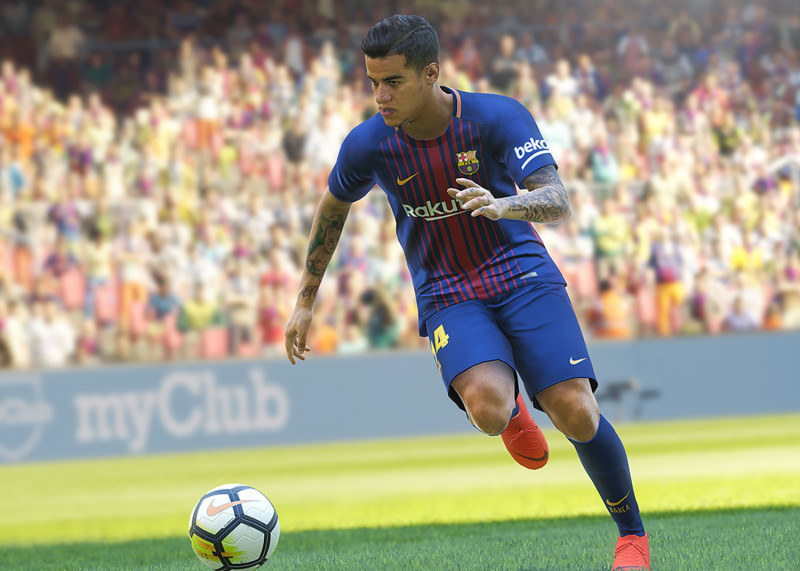
Pro Evolution Soccer’s gameplay has captivated in past years, and after my hands-on with the game at E3 2018 I’m happy to say that realistic but eminently fun gameplay is still the series’ bedrock in PES 2019.
The main thing that strikes me about PES 2019’s gameplay is the ball itself. I’ve always liked the way PES’ ball has felt when shooting and for deliciously weighted through balls, and this year you can definitely see players reacting to it differently from last year. It may take an extra second for a player to bring down that chest-high lofted pass on the touchline or take an extra touch in order to get the ball under control. You can also see it in some passes, as a lofted pass with curve on it forces the recipient to adjust.
PES 2018 made a point to slow the game down, and ironically, the free movement of the ball makes the action tick along briskly even though PES brand manager Andre Bronzoni told me that nothing had been done to the game’s actual speed per se. PES 2019 features snow in appropriate stadiums, and although it does not accumulate, Bronzoni says it and rain will affect the ball.
Elsewhere on the gameplay front during my hands-on time I perceived that players got headers off quicker (requiring less of a windup) and fouls occurred when expected (for both teams) without it being a parade of yellow cards. This was a point of contention last year, and Bronzoni says that some leagues should be more strict about fouls (like in Brazil) than others (such as in Scotland).
Visable fatigue is new element of the game, and I certainly saw players with their hands on their knees while waiting for a throw-in, for example. The onscreen quick sub system (similar to FIFAs) can be used to adddress fatigue, but I don’t think players’ actual fatigue levels (viable in the pause menu) were different from last year. Despite this, pushing fatigued players will lead to injuries, and it will drain players’ overall stamina reserves game-to-game in the Master League mode.
The Master League is an area that PES 2019 needs to succesfully address, and one of the central components is the transfer system. Konami says it’s being overhauled <(a href="https://www.gameinformer.com/games/pro_evolution_soccer_2019/b/playstation4/archive/2018/05/09/pro-evolution-soccer-2019-officially-revealed.aspx">click for some more basic details on the game), but I did not get a lot of information on this front. I am, however, disappointed to hear that outside clubs don’t influence players' transfer prices during negotiations even though they’re listed as being interested the same player you are. Club prestige is a concept, however, that comes into play when it comes to whether players sign with your club or not. Smaller clubs will be out of luck for the big names until they are more established. This has been the case in past Pro Evos, so I’m unclear how PES 2019 is distinct.
MyClub is also getting a makeover, with the most notable being that Konami is releasing special versions of players through the year. It's also ditching the black ball system where scouts and agents based on certain player characteristics are stacked to increase the chances that you’ll pull the player you like.
MyClub in 2019 lets you see who you’re going to sign, although agents are still used to find specific players. Bronzoni wouldn’t say if the packs you’ll buy consist of players, agents, or a mix, but overall he says that the odds of gamers getting the players they want shouldn’t be vastly different.
The developer is still figuring out how it’s going to handle auctions – which had a useful two-stage bidding system – given the big changes to the mode, but the dual stars/GP currencies are the same. Moreover, users can still train players.
Nothing is written in stone just yet for PES 2019 – there are still a lot of details I'd like to know for the Master League and MyClub modes. We’ll have to wait and see how those shake out, but once again gains have been made on the gameplay front that certainly show that the game is putting its best foot forward.
The Last of Us: Part II opened Sony’s press conference with a bang. Not only did we meet a new character named Dina who’s obviously important in Ellie’s life, but we also saw a slice of the combat. As with any follow-up title, the next game always looks to improve on its predecessor, and true to Naughty Dog, it’s set on taking things to the next level. During E3 2018, I got the opportunity to sit with co-directors Kurt Margenau and Anthony Newman to discuss how combat has evolved and what we can expect from it the highly anticipated sequel.
Proving More Stealth Options
According to Newman, when the Naughty Dog team sat down to think about the game, it explored what worked well and what would be appropriate for this game and expand on what was done previously. “The Last of Us has always been about the natural world and reclaiming society and civilization, so a natural evolution of Last of Us 1 was to increase the vegetation in the world,” he explained. “That obviously plays into the stealth game that’s super important, so that pushed us to create this analog stealth system where based on your stance, whether you’re crouched, standing, or prone in the thickness of the vegetation you’re in, enemies have an easier or harder time seeing you. There’s this sliding scale of how susceptible you are. It’s more appropriate to the tension of the world of The Last of Us.” That means gone are the isolated patches, and instead, the environments offer lush, full forests that provide plenty of opportunities for Ellie to strategize.
Melee Has Been Revamped
In the demo, we saw Ellie dodging left and right as enemies attacked her. Naughty Dog added a dedicated dodge button this time around. “This allows us to do a lot more with melee,” Margenau said. “You can fight multiple enemies at once and [there are] all these cool contextual moves she does like planting off the surface and attacking with various finishers. We also have all the melee weapons, like she’s able to take a hammer off someone and use that.”
“That’s actually a new detail; if you don’t have a melee weapon beyond your switchblade and you’re finishing off someone who does have one, you can smoothly transition and grab that weapon from them,” Newman added.
Historically, melee has been animation-based, but more collision-based elements are being added to it. For instance, if a brute keeps swinging his hammer, he can hit stuff in the environment if he misses the player. “It’s kind of a small detail but it makes the system much more connected to the environment,” Newman explained. This has also enhanced the returning melee weapons, such as the machete and switchblade. Newman spoke to the movesets being more nuanced and complex than they were in the first game.
Taking Care Of Arrow Wounds
In the trailer, we saw Ellie face off against bow-and-arrow enemies. At one point, she gets an arrow stuck in her. This was not scripted for the demo; it’s something else you must consider as you battle menacing foes. When an arrow pierces you, it stays in you until you find a safe place to remove it. “While it’s in you, you don’t have access to listen mode and your aim is all out of whack,” Margenau said. “It’s the first status effect that we’ve introduced in the game,” Newman added.
Making Crafting Matter
Margenau confirmed there will be new craftable ammo for the bow and arrow, such as the explosive arrow we saw in the demo. “When we think about crafting such a core part of that experience in the Last of Us is the choice you make and what you give up when you craft it,” Margenau said. The team is always looking for what makes the experience unique as opposed to giving you a laundry list of items you can craft. It’s important there’s always something at stake. “It is a delicate balance of what options you give the player and what we showed is just a slice of what we’re planning,” Margenau teased.
A Different Fighter With More Enemies To Master
This entry is upping the ante with the weapons enemies use against you, such as bow-and-arrow users alongside different classes of the infected. Margenau spoke to one big adversary, who has a heavy melee attack and can throw Ellie through things and over things. He’s certainly no pushover; he can also block and parry your attacks. This doesn’t mean Ellie is defenseless against him, though. “This is obviously a harsh world and anybody who is going to survive in this world must become a very competent fighter,” Newman said. “Ellie has had five years to pick up some new tricks along the way.”
However, the team also had to think of how she would be a different fighter than Joel and what would make sense for her character. “She’s not as big or as bulky as Joel,” Newman explained. “She’s not going to be able to just overpower enemies with her raw strength.”
To compensate for this difference and to keep combat interesting, Naughty Dog added a dodge for the melee to increase complexity. A new addition is also a jump button to make environments more vertical. “This makes escaping more dynamic and frenetic,” Newman said about the addition. “Escaping is always an option,” Margenau added. “The squeezing through and hiding under things … you don’t always have to kill everyone.”
No Easy Way Out
While I discussed combat with Margenau and Newman one thing that kept coming up was the importance of tension, which they aren’t letting simmer in the slightest. “We’re trying to provide a lot more options for the player,” Newman said. “Overall, the level of threat that you’ll be facing means that you’re not going to be able to take things head on. Whether you want to do stealth or go loud with your combat, you’re never going to be able to do it without putting a lot of careful thought into what you’re doing.” The co-directors assured us they’ve expanded both the stealth and action playstyles. Naughty Dog wants players to have options and different ways to tackle every situation. “We’re not trying to make it more of an action game than The Last of Us,” Margenau assured. “It’s still a survival action game.”
To learn more about The Last of Us: Part II, check out that delves deeper into the narrative.
During PlayStation's E3 2018 press briefing, Remedy wowed attendees and viewers with the first trailer of its upcoming game, Control. The trailer was exciting but left more questions than answers. Thankfully, I met with Remedy to see the game in action and learn more about the company's mysterious new world.
Remedy has always been known for narrative-driven experiences, but creative director Sam Lake says the team wants to expand beyond what the studio is known for. “Coming out of Quantum Break, I was concepting this with Mikael Kasurinen, who is our game director,” he says. “We wanted to, first and foremost, create a deep and mysterious world – a many-layered world that players would be drawn back to even when they have played for a long time to explore, find secrets, and piece things together.”
In Control, you play as Jesse Faden, a person who had a traumatic encounter with the unexplainable as a child. The encounter changed her and left her with questions about what she is and what is possible in the world. In search of answers, she travels to the Oldest House, a massive Manhattan skyscraper where the secretive governmental organization in charge of investigating unexplainable things, the Federal Bureau of Control, resides. However, just as she arrives, a mysterious, supernatural force known as The Hiss attack the Oldest House, possessing the employees of the Bureau and killing the Director.
Not realizing what it is, Jesse picks up the Director’s gun. However, the gun is an Object of Power with the ability to morph and shift its powers. In picking up this weapon, Jesse becomes the new Director, placing a target on her back for the possessed Bureau employees. As Jesse turns a corner, a man holding a gun creepily walks toward her. He slowly looks at her and readies his gun. Jesse realizes what’s about to happen and pulls a portion of the floor up to block the gunfire. Turns out the gun isn’t the only powerful part of the main character. She then blasts the debris at the assailant, stunning him. Using her powers, she grabs a computer monitor from across the room and smashes it into him, knocking him down.
“The thing that we wanted from really early on was to make a really challenging experience.”
Exploring the Oldest House is easier said than done. In addition to the myriad enemies trying their luck at taking down Jesse, you also must deal with shifting walls and rooms. Remedy relies heavily on elements of new weird, a subgenre of science fiction revolving around a normal world being changed by a foreign object that is often unexplainable by human science, as well as dream logic. The building behaves unpredictably, but you can sometimes trigger these shifts by performing abstract rituals that require you to think outside the box.
“It’s a Place of Power on its own… this weird, shifting, strange place that’s vastly bigger on the inside than the outside would lead you to believe,” Lake says. “If you know the rules, if the conditions are right, if you know the right rituals, you can keep on traveling – essentially forever – deeper into this building. And step by step, also, leaving our known reality behind.”
Quantum Break placed a heavy emphasis on story, but Lake says this time around, the studio is more focused on the gameplay. Lake and Kasurinen also wanted to deliver a less linear experience where players would want to dive back in time and again to learn more about the world, complete challenges, and discover new things.
This is evident as Jesse comes to a big, long room with multiple doors. Each door leads to different area, giving the Oldest House sandbox elements. As Jesse continues down the path, she comes to a chasm with seemingly no way across. The demoer says that to pass this gap, she must unlock the Levitate ability. Thankfully, Jesse already has this ability, so there’s no need to backtrack to find it. Jesse effortlessly glides across and continues down the path.
As you play, you encounter multiple side-missions. The optional quest I see is a guy who’s stuck staring at a refrigerator. He tells Jesse he’s been stuck staring for days without rest or food and he’s hoping she can relieve him of his duties. I’m not sure what that would entail, but there’s no time for that. Jesse leaves the poor soul behind and continues along her way.
As the demo nears its end, Jesse encounters Rooney, the head of security. Unfortunately, the Hiss have gotten to him as well, and he is much more powerful than any other enemy she’s encountered at this point in the demo. Rooney possesses similar skills as Jesse, but he seems faster and has more projectiles. After shooting him and smashing him with several pieces of debris, Rooney gives one last-ditch effort, but Jesse expertly dodges it and delivers the killing blow.
Jesse leaves the room and enters a bright, white room. She walks toward a massive upside-down black triangle – The Astral Plane. The demo ends after the impressive boss battle, and I’m left wondering what will await her in the Astral Plane.
Control feels like the ultimate realization of what Remedy has attempted in past games. “I would like to think that with each project, we learn what works and what didn’t work that well,” Lake says. “We always want to bring in new elements and try out new things. Here, I think we’ve done a bit more of that than times in the past. But also, I feel there will be a lot of things that the fans will see the evolution of and where certain things have come from.”
The more open structure, the powers Jesse wields, and the abstract shifting building lead to a complex title to wrap your head around. Control looks to keep players on their toes more than other Remedy games.
“The thing that we wanted from really early on was to make a really challenging experience,” Lake says. “We are dealing with weird concepts, but also from the gameplay side and storytelling side, if you have a linear game, what you end up doing is you are holding the player’s hand and leading them through the experience. ‘Look now, here is the next thing. And you go straight down the hall, and then you see the next thing.’ We decided very early on that this is hands off. We are not helping. We want this to be more player-driven, and the player goes in and pursues the things they are interested in. We are serving fewer things on the platter for you, and leaving you more to piece together for yourself, and try out and experiment, and discover, and learn. We do believe that this will make it more engaging and more rewarding.”
I can’t wait to see what else Control has in store when it launches in 2019.
Avalanche Studios has been delighting E3 ongoers all week with an action-packed demo of Just Cause 4, and if you’re looking for a traditional preview of what they showed, Javy . However, he’s not the only one who saw the tools of destruction that Rico Rodriguez is packing this time around. Jeff Cork and Jeff Marchiafava also sat in on the demo, with a laser focus on the kind of stupid fun in-game pranksters can look forward to. Rather than keep their ruminations to themselves, they decided to memorialize their thoughts about Just Cause 4 in a text conversation, which you can conveniently view below. You’re welcome!
Jeff Cork: Hello, Jeff Marchiafava! Remember when we saw the Just Cause 4 demo together? What was the biggest surprise for you? Personally, I wasn’t expecting to learn that the tornadoes that were highlighted in the reveal trailer are being controlled by various factions in the game through some kind of weird array of high-powered fans. And no, I am not making that up. The tornadoes in the game are, indeed, being controlled through some kind of weird array of high-powered fans.
Jeff M: Conspiracy theorists rejoice – the government really is controlling the weather! I think the biggest surprise for me was that apparently Avalanche can read my mind and decided to tailor-make Just Cause 4 into exactly what I want from the series – a big dumb playground for me to mess with NPCs in ridiculous ways.
Jeff C: Sure, you could shoot them with your guns, but that’s amateur-hour stuff. During the demo, we got to see all kinds of wacky nonsense. I think they know their audience perfectly; rather than focus on the various socioeconomic conditions that have led to the downfall of this region, we got to see a lengthy masterclass about how physics can be fun. Rico’s repertoire has been enhanced with an upgraded grappler, allowing for even more mayhem. We all had fun using boosters to rocket people, cars, and other things away, but Just Cause 4 puts it on a completely different level. We saw it in action as the demoer methodically shot booster after booster at a crane and cargo container and stuck them together with a tether. Moments later, the contraption sprung to life, whirling around like an out-of-control wrecking ball and ruining everything within its radius.
Jeff M: Yeah, I was delightfully surprised to see that you can customize a bunch of characteristics for how your grappler functions, seemingly for the express purpose of causing goofy shenanigans. Some of the options don’t even make sense in any logical circumstance – why would you ever need a tether that continually contracts and expands between to objects? That only makes sense when you’re trying to do something stupid, and I love that they give players the option. Should we talk about the damn balloons now?
Jeff C: Rico can fire off balloons now, which inflate and – you’re not going to believe this – lift whatever they’re attached to into the air. “Whatever” probably includes what you’re thinking about already. You want to pretend you’re a cutrate Snake and whisk people away with your phony Fulton? They won’t be added to your roster, but your victims will float away. Close enough? You can also put them on the corners of the top of a storage container and create a floating mobile platform – one that, when combined with boosters, can fly you around until it probably slams into a mountain or spirals out of control. You can also equip a mod that lets the balloons follow you around, so you can have a conga line of red barrels above you. Why? I don’t know. Maybe drop them and they’ll explode on your enemies? Asking “Why?” seems fairly fruitless, as you said.
Jeff M: Yeah, unlike the Fulton, there really isn’t a point to it beyond “more physics-based fun,” and that’s good enough for me! I’m really looking forward to diving into the grappler customization and seeing what hilarious combinations you can come up with. The biggest news, however, might be that Avalanche even figured out a way to make the weather fun! Apparently the entire island has simulated wind patterns, which make getting around with Rico’s windsuit a little easier – though I doubt it will stop me from smashing into the sides of mountains. Avalanche said Just Cause 4 simulated a number of weather conditions as well, but the one they were showing off was the aforementioned tornadoes.
Jeff C: They seem to spin real good. During the demo, we saw one tear through an enemy outpost, where it tore up nearly everything in its path – including the red chaos objects, which ordinarily reward Rico with points for destroying them. Guess what? You still get credit for blowing up those generators, gas tanks, and towers, even if the tornado is technically doing all the work for you. He’s not lazy, he’s enterprising! Those chaos objects have a little more utility this time around, beyond blowing up nicely when shot at. For instance, you can put balloons on a gas tank, blow out the back of it, and watch as the resulting jet flame propels the tank away like a missile toward some enemy fighters. And then, of course, it explodes because it’s still Just Cause.
Jeff M: It is indeed more Just Cause, which is exactly what I wanted from the series in the first place. The new island seems massive and varied, the destruction physics have been kicked up a notch, and everything is gorgeous. I think the real fun is going to be experimenting – Rico has a new box of toys, and I look forward to playing with them!
Jeff C: Boom.
After the admirable Souls clone Lords Of The Fallen, Deck 13 tried its hand at a sci-fi action game called The Surge. The had some great narrative concepts that never realized their potential as well as a fun combat system centered around dismemberment that was brought down by receptive enemy types and a lackluster environment.
With The Surge 2, Deck 13 seems to have embraced all of these criticisms and worked hard to address them in the sequel. The result, from what we’ve seen from a demo presentation, is a promising action-adventure game that presents an intriguing world filled with secrets and hectic combat encounters.
Gone is the forgettable protagonist (seriously, what’s that dude’s name?) from the first game. With The Surge 2, you’ll have a character creator to make you own protagonist, customizing their gender and looks. The weapon types from the original game have been doubled, expanding from 5 to 10, with the new additions functioning a lot like the trick weapons in Bloodborne. That’s not the only thing that Deck 13 seems to be borrowing from From’s beloved Souls offshoot.
The enemies in the first Surge were essentially mindless, robotic zombies or massive machines that gave a challenging fight but weren’t exactly memorable. In The Surge 2, we watched as our heroine squared off against human mercenaries, all decked out in advanced armor capable of cloaking, that moved and acted much like the hunters from Bloodborne.
These duels were frantic, with our demoer having to adapt and dodge whenever one of the mercs cloaked and disappeared out of a sight, the only clue to which direction they were going being a tree limb or patch of long grass moving before the foe struck. Killing these enemies allows you to gain access to their tech depending on which limb finisher you cut off. During the first encounter, the demoer finished off the first opponent by tearing through his arm with an axe. The reward? A floating pistol that they could summon at any point to attack someone. The pistol doesn’t do much damage but is a nifty gadget capable of luring foes into traps or stunning them. Other armor attachments will give you different abilities, making combat not only visually striking (with finishers rending heads or tearing foes in half) but also constantly offering enticing rewards.
The environments are also a big step up from the original game, with the samey factory setting being replaced by the futuristic, quarantined city of Jericho. During the demo we watched the main character investigate a totally synthetic park created for the rich to enjoy. Massive guardians disguised as statutes hide, waiting for “undesirables.” The best part of the demo came when our heroine squared up against one of these guardians in a mini-boss fight that had the boss using a shield. After some crafty dodge work and a few shots from the pistol, the guardian’s shield went down and our demoer made an exciting, risky play, slashing and slamming into the boss and bringing it down. A flashy explosion marked the end of our demo.
The Surge was a promising title marred by a number of issues, all of which the Surge 2 seems to be rectifying. We’re excited to see what else this sequel has to offer when it releases on PS4, Xbox One, and PC in 2019.
As part of Microsoft’s massive E3 conference, Phil Spencer introduced a fighting game from Bandai Namco as a way of communicating Microsoft’s commitment to Japanese games. The trailer showed Dragon Ball’s Goku and Freeza, the titular character of Naruto, and Luffy from One Piece all fighting each other in realistic modern environments. Bandai Namco introduced the world to Jump Force, a 3D fighting game celebrating manga magazine Shonen Jump’s 50th anniversary.
The story of the game is that our world – that is to say, the real world – is colliding with the world, or worlds, of various Jump series. Unlike previous Jump crossover games, Jump Force is intended to have a story mode explaining why the various heroes and villains are clashing, though Bandai Namco would not tell us the reason quite yet. They only hinted that it would involve the machinations of Light and the Shinigami Ryuk, who were seen observing the fights from the top of a building at the end of the reveal trailer.
The fights take place, at least from what we were shown, in real-world locations. At E3, the only two levels shown were New York City and the Matterhorn, rendered with fairly realistic graphics. There weren’t any citizens fleeing from Naruto’s Kyuubi super or Freeza’s finger lasers, which is good, because that might have been a bit too much to take in.
The actual gameplay of Jump Force is not dissimilar to 3D fighting games already associated with the respective series. Mashing buttons will often get you exactly what you want to happen, usually a disappearing act as you dart across the arena and use your opponent as a volleyball. Holding a shoulder button and combining it with attacks gets you special moves like Goku’s Kamehameha, Luffy’s Gum Gum Pistol, or Naruto’s Rasengan. In that respect, the ease of execution is very similar to Smash Bros. more than, say, Dragon Ball Budokai or Naruto Ultimate Ninja Storm.
The combat at the moment, however, is a little slow and unvaried. Characters all move at about the same speed and seem to have a lot of the same combos, making them feel extremely similar outside of their special moves. Mobility doesn’t seem that different between One Piece’s Zorro and Dragon Ball’s Goku, giving the possibly intentional impression that the game is designed to simply be picked up and played for anyone with any favorite character.
Bandai Namco wouldn’t give up the roster for the game, but hinted that there more than a few surprise characters that fans wouldn’t think of. While fighting ability and popularity are important factors, being able to please fans of more niche series is also a major goal for the development team.
Jump Force is scheduled to release in 2019 on PlayStation 4, Xbox One, and PC.


 Fallout 76 release date